Ballast and Brick

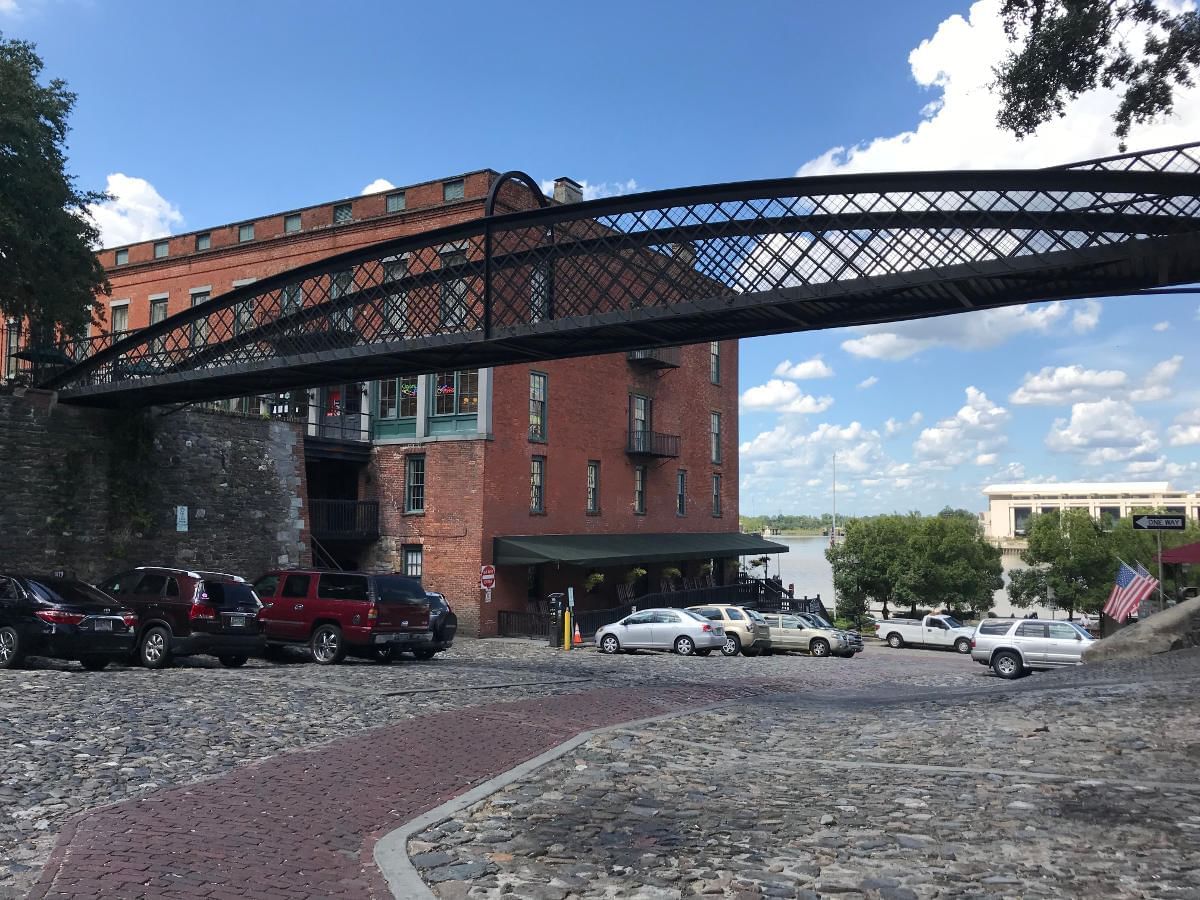
Early foundations and roads on River Street were constructed using ballast stone, imported from England in the late 18th and early 19th centuries. This stone was used as ballast to stabilize empty ships. Upon arriving in Savannah, the stones were offloaded, and the ships were filled with cotton (the “gold” of the era). Locals discovered that these stones were both abundant and cost-effective for construction. The foundation and first floor of the River Street Inn showcase English ballast stone. Later in the 19th century, Savannah Grey brick began to replace ballast stones, as evidenced by the mixed-material construction of the two lower floors.

Landscape view of the flyover over the car park at River Street Inn

Just the Fact(or)s

A Factor was essentially a trader who bought and sold goods. In the early 1800s, Factors occupied spaces within the buildings along River Street to conduct business related to the goods arriving by ship. They dealt in a wide range of items including hardware, pharmaceuticals, jewelry, clothing, liquor, and cotton, all of which were housed in commercial rental units leased by Factors. As Savannah's bustling port grew, so did the size and scope of the buildings. To create access to the upper levels of these buildings, an access road called Factor’s Walk was created.

Deadbeats Beware!

While Factoring could be lucrative, not all tenants managed to pay their rent from their earnings. Those who fell behind would see their goods auctioned off to settle their outstanding rent. This practice, as highlighted in the ad below, could significantly hinder a Factor's chances of securing future rental agreements.

Ranges Rise from River Street

Between 1809 and 1877, substantial buildings known as Ranges were constructed along River Street. These Ranges housed offices, warehouses and other commercial spaces. The River Street Inn is situated within the Claghorn Range and the Jones Derenne Range, also known as Jones' Lower Range.

Fireproof Stores

After the completion of the two adjacent Ranges in 1857, tenants were invited to lease the newly available "Fireproof Stores." The Great Savannah Fire of 1822 had destroyed many buildings between Bay and Broughton Streets. In response to these fires, the city began promoting the use of ballast stone and brick to reduce the risk of future fires. Additionally, Savannah updated its building codes, mandating that each structure keep buckets of water on hand for emergencies.

Exotic Gives Way to Practical

As the Ranges were completed in the 1850s, factoring along the river had become less common. In its place, businesses emerged to support Savannah’s booming population and industrial growth. By the late 19th century, instead of hardware and jewelry, stores were selling petroleum, guano (fertilizer made from bird excrement), lumber, pitch, and of course cotton.

River Street Revitalization

By the 1930s, the Great Depression had taken its toll on River Street, leaving only the timber shipping industry profitable. River Street fell into disrepair, with abandoned warehouses and empty storefronts. By the early 1970s, only four shops, one restaurant, and one bar remained. In 1975, the City of Savannah approved the Urban Renewal River Street project, a $7 million investment that transformed 80,000 square feet of abandoned warehouses into shops, restaurants, and galleries..

The Night Flight

One of River Street’s most beloved institutions, the Night Flight, operated from the first floor of The River Street Inn from 1975 to 1985. Its legendary music and bar scene featured performances from iconic artists like R.E.M., Lyle Lovett, Vince Gill, Natalie Merchant and Jimmy Buffett, among many others.

Exterior view with historic architecture and waterfront at River Street Inn

The River Street Inn

The River Street Inn opened in 1986 with 42 rooms in the East Lot (Claghorn Range). In 1999, an additional 42 rooms were added in the West Lot (Jones Derenne Range), followed by 13 more rooms in 2019 that were added as part of a multi-million-dollar renovation, also in the West Lot. We look forward to serving you for many years to come!